
Strategy as Team Sport
November 15th, 2025 — Montreal Qc, Canada
Strategy Isn't a Department. It's a Superpower Everyone Should Have.
Most companies treat strategy like a rare wine—locked away in a special department, handled only by certified experts, brought out for special occasions. The result? Strategy at many companies is almost completely disconnected from execution, and brilliant plans gather dust while teams build things nobody needs.
At Leeroy, we killed our strategy department. Not because we don't believe in strategy—because we believe in it so much that we refuse to quarantine it.
The Department Delusion
Here's what happens when you trap strategy in a department: the people making strategic decisions never get their hands dirty with implementation. They lack the context that comes from wrestling with a thousand small decisions that either support or sabotage the big vision.
I learned this lesson the hard way at Mirego. We had brilliant strategists who could craft compelling narratives and identify market opportunities. But when it came time to execute, something was always lost in translation. The development team would question fundamental assumptions. The design team would discover user needs that contradicted the strategy. The business team would encounter market realities that nobody had considered.
Every handoff became a game of broken telephone. By the time the strategy reached the people who actually build things, it was either completely misunderstood or completely ignored.
The Complexity Trap
Most high-level strategies have hundreds of ways they can be translated into action, and here's the uncomfortable truth: no single strategist can master all the disciplines required to navigate that complexity. Modern problems require insights from technology, design, business development, user experience, data analysis, and market research—simultaneously.
The traditional model asks one person (or one department) to synthesize all this complexity, then hand down wisdom to the teams who actually understand these domains. It's backwards. The expertise lives in the trenches, not in the ivory tower.
Think about it: how can a strategist make informed decisions about technical feasibility without understanding the codebase? How can they evaluate user experience implications without knowing the design constraints? How can they assess market timing without understanding the operational realities?
They can't. And they shouldn't have to.
Strategy as Team Sport
The most successful cross functional teams typically share the following traits, which set the stage for high performance and sustainable results: Mixed Skill Sets: Members bring varied expertise, backgrounds, and perspectives, creating a rich environment for innovation and problem-solving.
This is exactly what strategic thinking requires. At Leeroy, we've made strategy everyone's job. Not because we want chaos, but because we want decisions that stick.
Our approach centers on three interconnected elements—what we discovered at Mirego and refined at Leeroy. Think of it as the strategic trinity: Technology (what's possible), Business (what's profitable), and Ideas (what's meaningful). No single person can master all three, but a collaborative team can synthesize them beautifully.
When your developer understands the business case, they make different technical choices. When your designer grasps the strategic vision, they solve different problems. When your business development team understands the technical constraints, they pursue different opportunities.
The Context Problem
Strategy departments suffer from what I call "the context problem." A corporate strategy department functions as a coordinating body, developing and implementing strategies that satisfy the objectives of individual departments as well as promoting overall corporate goals. But coordination without participation leads to strategies that sound smart in PowerPoint and fall apart in practice.
Here's why: strategy isn't just about the big decisions—it's about the thousand micro-decisions that either reinforce or undermine your strategic direction. The font choice that either supports or contradicts your brand personality. The API design that either enables or constrains future product evolution. The pricing model that either attracts or repels your target audience.
The people making these micro-decisions need to understand the strategic context. They need to be part of the strategic conversation, not recipients of strategic mandates.
The Handoff Horror Show
Organizations that struggle with strategy execution have three common barriers or challenges: ambiguous responsibilities, an inability to cascade objectives to teams and individuals, and lack of clear priorities.
Every time you hand off a strategy from one team to another, you lose fidelity. Context gets lost. Assumptions get questioned. Decisions get re-litigated. What started as clear strategic direction becomes organizational telephone, with each team interpreting the message through their own lens.
We've all been there: the strategy team presents their brilliant plan, then disappears. Six months later, when the execution team is struggling with unforeseen challenges, the strategists are already working on the next big thing. The institutional memory is gone. The rationale behind key decisions is forgotten. The strategy becomes a historical document rather than a living guide.
The Evolution Playbook
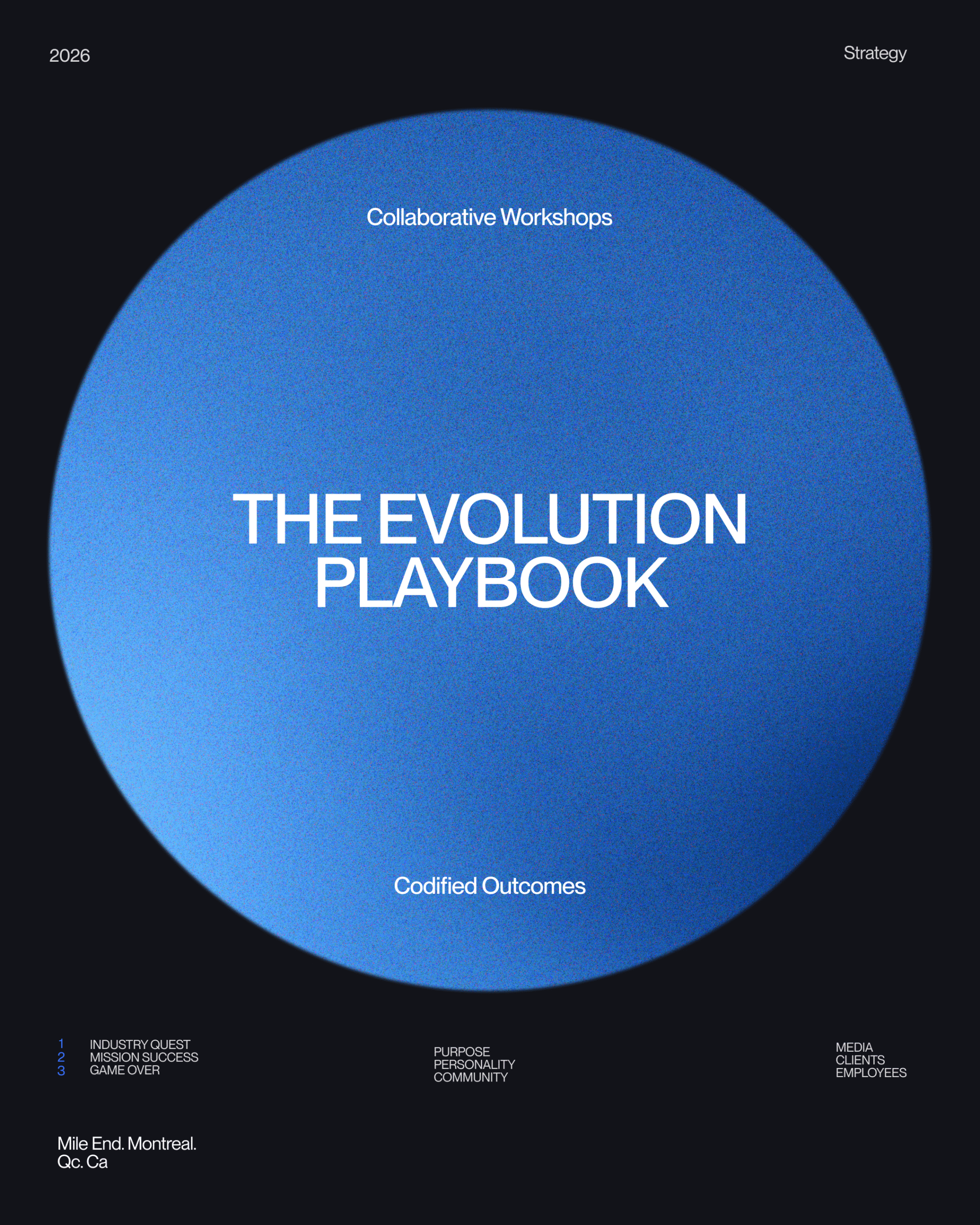
Instead of strategy documents that nobody reads, we create what we call Evolution Playbooks—living documents that everyone contributes to and everyone uses. Think of it as strategy made actionable, with everyone having skin in the game.
Our Evolution Playbook includes:
The Brand Triforce: Purpose (why we exist), Personality (how we behave), and Community (who we serve). This isn't marketing fluff—it's strategic infrastructure that guides every decision from product features to communication tone.
Audience Understanding: Deep insights into our communities using frameworks like APC (Art-Product-Culture) and generational research. Because strategy without audience insight is just wishful thinking.
Product Roadmap: Not just features and timelines, but strategic bets about where the market is heading and how we'll get there first.
The Strategic Fit: This is where the magic happens. We define our strategic concept—the unique behavioral approach that sets us apart. For one client, we "act as the underdog." For another, we "play the sass card." For Liquid Death, we brought "80's campaign energy with a heavy metal twist."
These aren't taglines—they're decision-making frameworks that everyone can apply to their daily work.
Making Strategy Stick
Cross-functional collaboration is the secret sauce that fuels innovation and efficiency in modern organizations, and this is especially true for strategy. When everyone understands not just what to build, but why to build it, magic happens.
The developer who understands the strategic vision writes cleaner, more purposeful code. The designer who grasps the audience insights creates more resonant experiences. The salesperson who knows the competitive positioning has better conversations with prospects.
But this only works if everyone has a voice in shaping the strategy. Cross-functional team members already have their own daily work on their plates, so the last thought a relevant meeting should provoke is "This really could have been an email". The key is making strategic thinking part of the work, not additional work.
Don't Confuse Strategy with Planning
Here's a crucial distinction: strategy is not a plan. Plans are about sequence and resources. Strategy is about choices and trade-offs. You need both, but they're different muscles.
Strategy teams often lack execution plans, while execution teams often lack strategic context. The result? Strategic paralysis or tactical chaos. Our Evolution Playbook bridges this gap by making strategy concrete enough to guide daily decisions while keeping it flexible enough to adapt as we learn.
The Distributed Future
Cross-functional collaboration: The magic happens when different departments join forces. Fostering collaboration between these functions opens the door to innovation and synergy.
We're moving toward a future where strategic thinking is distributed throughout the organization. Where every team member understands not just their role, but how their role advances the larger mission. Where strategy isn't something that happens to you, but something you actively participate in creating.
This isn't about eliminating strategic leadership—it's about democratizing strategic thinking. The best strategies emerge from the intersection of diverse perspectives, not from the isolation of strategic departments.
Your Strategic Imperative
The companies that will thrive in the next decade are those that turn strategy from a department into a discipline. From a document into a mindset. From a one-time planning process into a continuous conversation.
Stop treating strategy like a rare vintage that only experts can handle. Start treating it like oxygen—something everyone needs to do their best work.
The question isn't whether your organization needs strategy.
It's whether you're brave enough to let everyone help create it.